
Event Project Work Types Explained: From Freelancer to Project Manager
Most people think the event industry has only two kinds of people — the ones dancing on stage and the ones “managing everything.”
Reality is far messier. And far more interesting.
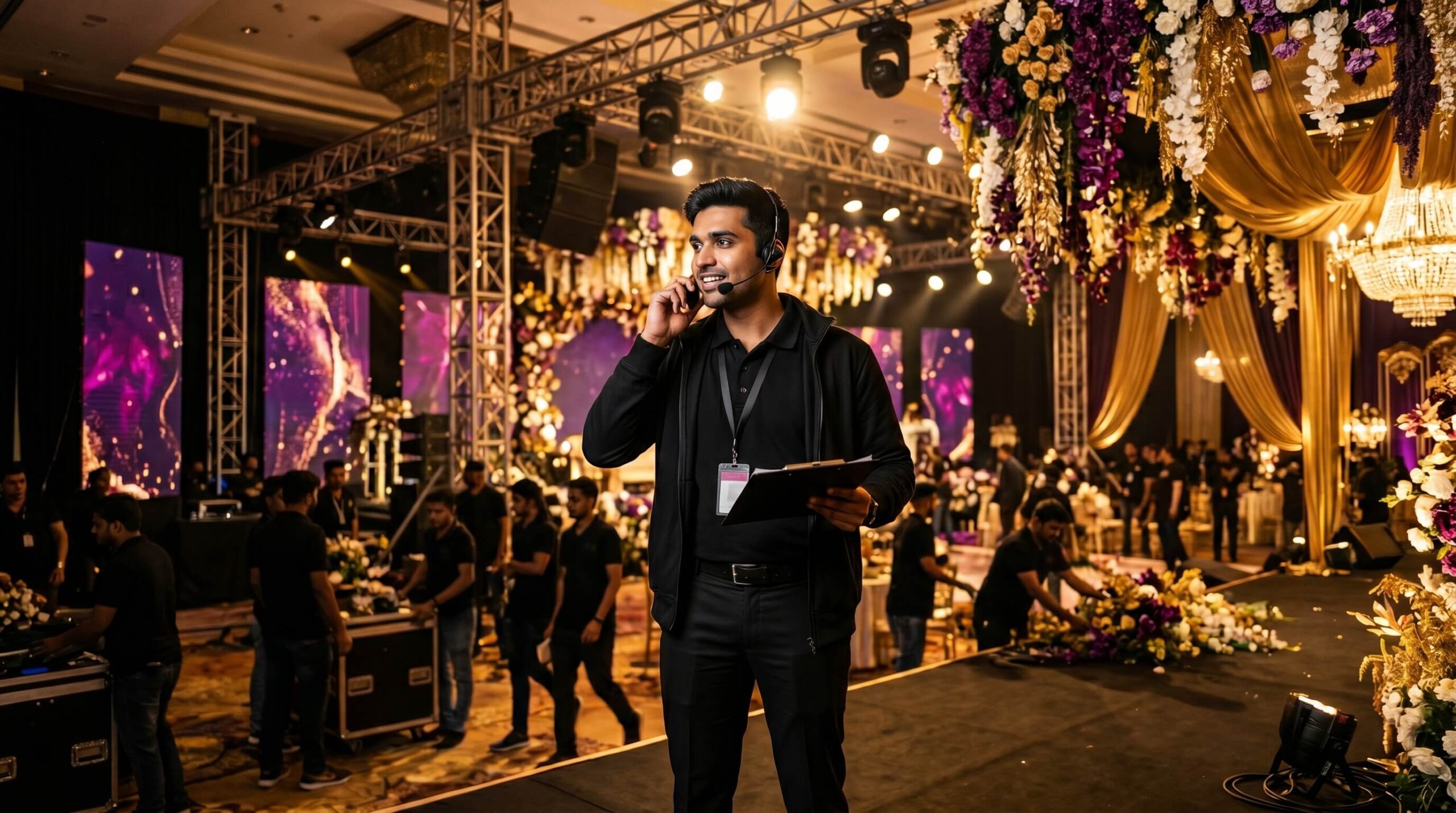
Behind every luxury wedding, IPL activation, college fest, or celebrity concert is an invisible army of freelancers, backstage coordinators, logistics experts, hospitality teams, vendor managers, and temporary project heads working under brutal timelines and impossible expectations.
One delayed truck can ruin an entry sequence.
One missing artist coordinator can create chaos backstage.
One weak production manager can collapse a ₹50 lakh setup before guests even arrive.
What most outsiders don’t realize is that event management is not one job. It’s an ecosystem of project-based roles.
And if you understand these work types properly, you stop randomly “looking for event work” and start positioning yourself strategically inside the industry.
That difference changes careers.
The main event project work types include freelancing, department handling, contract execution, subcontracting, and temporary project management roles. Each role requires different skills, responsibilities, and pitching strategies — from handling backstage operations to managing full-scale event execution with vendors and teams.
In this article, we break down how each role works in the real event industry, how beginners actually get hired, and what most people misunderstand about event careers in India.
Why Most Beginners Get Confused About Event Careers
Most beginners enter the event industry with one vague goal: “I want to work in events.”
But the industry itself doesn’t work vaguely.
Different event roles require completely different mindsets, skill sets, stress tolerance, and execution abilities. Someone excellent at hospitality may fail badly in production. A strong backstage coordinator may struggle with client handling.
What actually happens behind the scenes is this:
event companies hire based on operational reliability, not passion alone.
And this is where most newcomers get it wrong.
They try becoming “everything.”
The industry rewards specialists first.
“In events, the person who solves pressure fastest becomes the most valuable person in the room.”
From our experience at Events Expert Academy, students who identify their execution strength early grow significantly faster than those chasing every opportunity blindly.
If you still don’t fully understand the foundation of the industry, start with what is event management because the structure of this industry is very different from traditional corporate careers.
And once real execution begins, freelancing becomes the first battlefield.
What Is Freelance Event Work Actually Like?
Freelance event work is the most flexible entry point into the event industry. But flexibility should never be confused with randomness.
A freelancer is usually hired project-to-project for specialized operational support. You may work at a wedding this weekend, a concert next week, and a corporate summit after that.
The Biggest Mistake Freelancers Make
Most beginners accept every role available:
- Hospitality today
- Registration tomorrow
- Backstage next week
- Artist handling after that
This creates experience.
But not positioning.
The smarter approach is choosing one or two departments and becoming unforgettable in them.
Common freelance specializations include:
| Freelance Department | Typical Responsibilities |
|---|---|
| Hospitality | Guest coordination, welcome flow |
| Backstage | Stage movement, cue coordination |
| Artist Handling | Celebrity movement, green room operations |
| Content Support | Reels, BTS content, social media |
| Registration | Entry systems, guest data |
| Logistics Support | Vendor movement and coordination |
How Freelancers Actually Get Work
The transcript mentions a brutally practical truth:
owners rarely give ground-level freelance work directly.
Operations managers do.
Production heads do.
Execution leads do.
That small detail changes networking strategy completely.
Instead of sending generic “Sir any work?” messages, smart freelancers:
- Research event companies deeply
- Understand their event style
- DM with specific department value
- Offer outcome-focused help
LinkedIn stalking sounds funny until it gets you paid.
Behind the scenes, event companies quietly keep “trusted freelancer lists.” Once your name enters that list, repeat work starts coming naturally.
“The event industry remembers dependable people longer than talented people.”
This is also why helping other teams during execution matters. One extra act of support backstage often creates the next project opportunity.
If you’re exploring whether this career fits your personality long-term, read is event management right for you.
But freelancing is only the beginning. Department work is where real authority starts appearing.
How Department-Based Event Work Changes Your Positioning
Department work means you stop being “extra support” and start becoming responsible for a complete operational vertical.
That shift is massive.
You are no longer just executing tasks.
You are reducing the planner’s stress.
Typical department responsibilities include:
- Guest management
- Logistics coordination
- VIP movement
- Green room management
- Hospitality systems
- Artist support operations
Why Planners Pay More for Department Teams
Event planners don’t buy manpower.
They buy reduced chaos.
When a planner hands over hospitality to a reliable department lead, they mentally remove 100 micro-problems from their own head.
And that trust becomes expensive.
From actual event execution experience, the strongest department leaders usually have:
- SOP systems
- Backup staff
- Communication structure
- Escalation flow
- Reliable replacement resources
The part nobody talks about is that event planners fear uncertainty more than cost.
A slightly expensive but dependable department team almost always wins over a cheaper unpredictable one.
The “Guaranteed Model” That Builds Trust
One insight from the transcript stands out strongly:
“Pay only if you like the work.”
That outcome-based positioning works because event clients and planners care about execution quality — not effort stories.
At Events Expert Academy, we constantly teach students that event pitching should focus on:
- Problems solved
- Pressure handled
- Guest experience improved
- Time saved
Not motivational speeches.
“Luxury events survive on invisible systems, not visible glamour.”
And once department handling becomes stable, the industry opens the door to contract work.
What Happens in Contract and Subcontract Event Work?
Contract event work is where operational responsibility becomes financial responsibility.
This is no longer simple freelancing.
You may take complete responsibility for:
- Sound setup
- Lighting execution
- Decor production
- Fabrication
- Technical systems
- Stage production
And suddenly, vendor delays, billing fights, transport failures, and client pressure all become your problem too.
Why Contract Work Looks Glamorous But Feels Brutal
On Instagram, production setups look cinematic.
At 3:12 AM during rain with delayed trussing trucks? Completely different story.
What actually happens backstage:
- Vendors fight over timelines
- Electric loads fail unexpectedly
- Decor teams overlap with sound teams
- Last-minute client changes destroy planning
- Entry sequences get revised minutes before execution
And yet the event must still look effortless.
That emotional pressure separates serious professionals from casual freelancers.
Case Study — Why Large Events Depend on Specialized Contractors
When large-scale Indian weddings like the Anant Ambani and Radhika Merchant Pre-Wedding Celebrations dominated global headlines in 2024, audiences saw celebrities, performances, and décor.
What they didn’t see:
- Multiple logistics command centers
- Parallel vendor coordination teams
- Temporary hospitality systems for thousands of guests
- Dedicated backstage production departments
- 24/7 setup rotation crews
Mega-events operate through layered subcontract ecosystems.
One contractor rarely handles everything.
This is why trusted vendors become career-defining assets in event management.
If weddings interest you specifically, explore how to become a wedding planner in India and understand how large-scale wedding execution actually works.
And eventually, some professionals stop handling departments alone and begin managing entire projects.

What Does a Temporary Project Manager Really Do?
A temporary project manager works like a full-time planner without necessarily being permanently employed by one company.
This role exists heavily in:
- Weddings
- Corporate events
- Brand activations
- Exhibition projects
- Experiential marketing campaigns
Why Companies Hire Temporary Project Managers
Because experienced execution brains are rare.
A good project manager already understands:
- Vendor flow
- Guest movement
- Setup timelines
- Team psychology
- Client pressure handling
- Backup planning
- Budget prioritization
They don’t need micromanagement.
That saves companies enormous operational energy.
Outcome-Based Pitching Changes Everything
One of the smartest points from the transcript is this:
highlight outcomes, not activities.
Weak pitch:
“I have worked on many events.”
Strong pitch:
“I reduced guest entry delays by 40 minutes during a 3,000-attendee event.”
See the difference?
One sounds emotional.
The other sounds valuable.
At Events Expert Academy, this is exactly why practical execution training matters more than theoretical learning.
Because real events reward systems under pressure.
Not classroom definitions.
“The most important 10 minutes of an event are often the 10 minutes before guests enter.”
And that pressure becomes addictive for the right kind of person.
Which Event Work Type Is Best for Beginners?
The best starting point depends entirely on your personality, energy style, and stress tolerance.
Here’s the practical breakdown:
| Work Type | Best For | Biggest Advantage | Biggest Challenge |
|---|---|---|---|
| Freelancing | Beginners | Flexible learning | Inconsistent work |
| Department Handling | Organized executors | Higher authority | Team pressure |
| Contract Work | Technical specialists | Bigger payments | Vendor responsibility |
| Project Management | Experienced planners | Strategic control | High stress |
| Subcontracting | Network-driven professionals | Scale potential | Operational risk |
The Career Path Most Professionals Follow
Most event professionals grow like this:
- Freelancer
- Department coordinator
- Department lead
- Contractor or project manager
- Full-scale planner or agency owner
Rarely overnight.
And honestly? That’s a good thing.
Because events punish fake confidence quickly.
If you’re serious about building long-term industry skills, practical exposure matters far more than motivational content. That’s why programs like the online event management course in India and hybrid event management course are becoming more valuable than purely theoretical classroom models.

The Hidden Reality Nobody Talks About in Events
The industry looks glamorous from the audience side.
But backstage?
It’s controlled chaos powered by emotionally strong people.
There are moments when:
- Teams work 20-hour shifts
- Coordinators eat after guests leave
- Production crews sleep beside stage structures
- Hospitality teams solve emotional family drama
- Managers smile externally while firefighting internally
And still…
When lights turn on.
When guests react emotionally.
When an entry lands perfectly.
When thousands experience a moment exactly as imagined —
the exhaustion suddenly makes sense.
That emotional payoff is why people stay in this industry for years.
Smile Events and Events Expert Academy were built around this exact reality: event management is not just planning. It’s emotional architecture executed under pressure.
And once you experience that rush properly, normal desk jobs start feeling very different.
Frequently Asked Questions
The main types include freelancing, department handling, subcontracting, contract execution, and project management. Each role has different responsibilities, payment structures, and stress levels depending on execution scale.
Yes. Freelancing is one of the easiest entry points because it allows beginners to gain live event exposure quickly. However, specializing in one or two departments helps build faster credibility.
A project manager oversees timelines, vendors, execution flow, team coordination, and client communication. They ensure the event runs smoothly from setup to final execution.
Technical production, luxury wedding management, artist handling, and large-scale logistics coordination generally offer higher income potential because they involve higher responsibility and operational risk.
Most freelancers get work through networking, referrals, operations managers, production heads, LinkedIn outreach, and repeat execution relationships built through reliability.
Yes — but it’s also highly rewarding for people who enjoy fast-paced environments, creativity, people management, and execution pressure. The stress usually comes from tight deadlines and live problem-solving.
Absolutely. Even creative planners need basic understanding of sound, lighting, staging, guest flow, logistics, and vendor coordination because events fail operationally before they fail creatively.
Final Thoughts
The event industry isn’t one career.
It’s dozens of overlapping careers hidden behind one glamorous label.
Some people thrive in backstage pressure.
Some become masters of guest psychology.
Some build vendor empires.
Some become elite project managers who quietly control million-rupee productions without ever standing in the spotlight.
But every successful event professional eventually learns the same lesson:
execution matters more than appearance.
Because guests only see the final three hours.
Event professionals carry the invisible 300 hours before that moment.
And honestly, that’s what makes this industry special.
The event industry doesn’t reward people who only love aesthetics. It rewards people who can create experiences under pressure. If reading this made you realize that this world genuinely excites you, then the next step is simple: start getting closer to real execution, real projects, and real backstage learning environments.

Your Career In Events Starts Here
India's most practical event management training. Real events. Real earnings. Real industry connections.