
Why Most Event Management Institutes Fail Their Students
One luxury wedding can generate income for over 50 vendors in a single night. A single IPL activation can involve hundreds of crew members working across branding, logistics, fabrication, hospitality, production, lighting, and crowd movement. Yet somehow, thousands of students still enter the event industry believing event management is mostly about glamour, celebrity selfies, and standing backstage at concerts.
That illusion is exactly what many institutes sell.
Instagram shows champagne towers. Red carpets. Five-star hotels. Bollywood celebrities walking past LED walls. But behind every successful event is something far less glamorous — strategy, chaos management, technical execution, budgeting, vendor politics, and sleepless problem-solving.
And this is where most event management institutes completely fail their students.
They prepare students for the appearance of the industry, not the reality of it.
The result? Thousands of students spend years collecting certificates while learning almost nothing about how events are actually built.
Most event management institutes focus heavily on glamour-based “practical exposure” instead of teaching real execution skills like budgeting, client handling, production planning, technical knowledge, and backend operations. Students often end up doing unpaid labor roles at events without learning transferable management skills.
In this article, we break down what real event management education should actually look like — from backstage realities to the skills that truly build long-term careers.
Why Is “Practical Exposure” in Event Management Often Misleading?
Most institutes advertise practical exposure like it is the holy grail of event education. But what they rarely explain is what kind of exposure students are actually getting.
And that changes everything.
A student standing outside a VIP gate for 12 hours at a cricket match is not learning event management. A student sticking branding stickers on chairs at 2 a.m. is not learning event strategy. They are functioning as low-cost manpower.
That is the uncomfortable truth nobody prints in brochures.
What most people don’t realize is that large events constantly require temporary labor. Many institutes quietly use students to fulfill those manpower needs under the label of “industry exposure.”
But exposure without mentorship is just exhaustion.
Selfies don’t pay bills. Skills do.
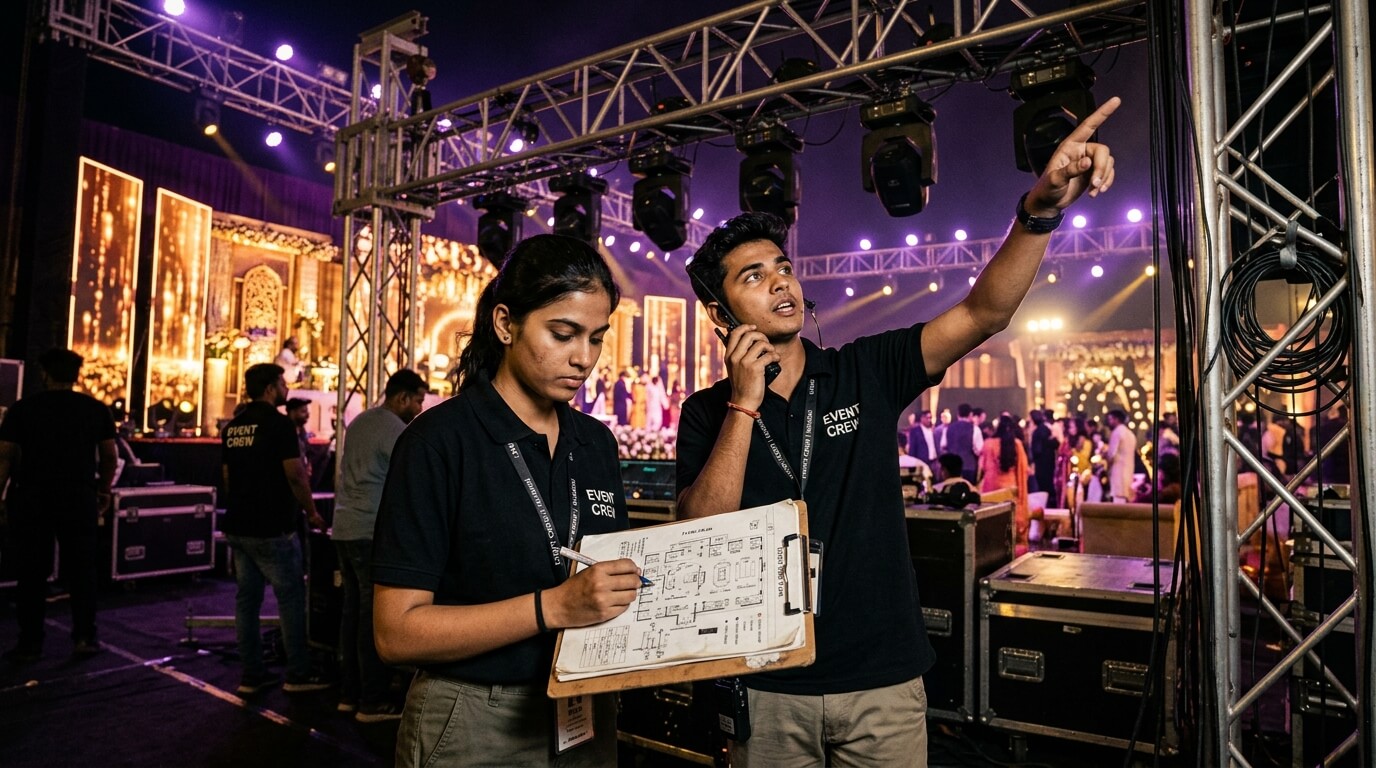
Behind the scenes, real event managers are doing something entirely different. They are calculating guest flow. Coordinating vendors. Managing stage timelines. Fixing last-minute technical failures. Negotiating budgets. Handling client emotions under pressure.
That is management.
And unfortunately, many students never get to see that layer.
From our experience at Events Expert Academy, the problem starts when institutes confuse visibility with education. Just because a student is physically present at a massive concert does not mean they are learning anything valuable.
The real question should always be:
What responsibility did the student actually handle?
Because that answer reveals whether the institute is building professionals — or simply supplying manpower.
And this is where the industry starts separating real education from marketing.
What Is the Difference Between Event Labor and Event Management?
Event labor helps events happen.
Event management makes events succeed.
The difference sounds small. In reality, it changes your entire career trajectory.
| Event Labor | Event Management |
|---|---|
| Checking tickets | Designing entry flow |
| Carrying boxes | Planning logistics |
| Standing at gates | Managing guest experience |
| Following instructions | Making decisions |
| Working physically | Thinking strategically |
| Temporary role | Long-term career skill |
This is the part no one talks about openly.
Many students spend years doing operational tasks without understanding why those tasks exist in the first place.
For example, during large-scale weddings handled by Smile Events, the visible event day is only the final layer. The actual event has already been “won or lost” weeks earlier through backend planning.
Lighting layouts. Vendor sequencing. Guest psychology. Movement mapping. Buffer timings. Rain backup plans. Artist hospitality. Power load calculations.
Guests only see the final magic.
Event managers see the thousands of invisible decisions underneath it.
The most important 10 minutes of an event are usually the 10 minutes before it starts.
A real institute should teach students how to think, not just how to follow instructions.
That means exposing students to every department:
- Production
- Client servicing
- Budgeting
- Logistics
- Creative design
- Technical operations
- Sponsorship
- Hospitality
- Vendor management
Because event management is not one skill.
It is controlled chaos management.
And the students who survive long-term are usually the ones who understand the entire machine — not just one glamorous corner of it.

Why Do So Many Students Only Want to Become Wedding Planners?
Most students don’t actually choose wedding planning consciously.
They choose what social media exposes them to.
That is the real issue.
Instagram has made weddings the “face” of the event industry. So naturally, students assume wedding planning is the only exciting career path available.
But the event industry is far bigger than weddings.
There are:
- Corporate launches
- Experiential marketing activations
- Sports leagues
- Music festivals
- Luxury brand experiences
- Government ceremonies
- Trade expos
- Celebrity events
- Tech conferences
- Destination hospitality events
And each world requires completely different skill sets.
A student who struggles in weddings may thrive in corporate logistics. Someone who hates budgeting may become exceptional at stage design. Another student may discover they are brilliant at sponsorship pitching.
But none of that happens if institutes keep students trapped in repetitive low-level roles.
You don’t discover your superpower by standing in a corner. You discover it by doing.
A good institute pushes students into multiple environments before specialization happens.
This is one reason why the modern hybrid learning approach used by Events Expert Academy matters so much. Students need exposure to both field execution and strategic planning.
Otherwise, they build confidence in the wrong areas.
And confidence without real skill becomes dangerous once real clients enter the picture.
Why Are Technical Skills So Important in Event Management?
You cannot manage what you do not understand.
This is one of the biggest gaps in traditional event education.
Many students graduate without basic knowledge of:
- Sound systems
- Lighting
- Trussing
- LED walls
- Stage dimensions
- Power distribution
- Fabrication basics
- AV production terminology
No, you do not need to become a sound engineer.
But you absolutely need enough knowledge to avoid being manipulated by vendors or making expensive production mistakes.
Imagine handling a luxury wedding ballroom in Mumbai where a vendor suddenly claims additional lighting load is required. If you have zero technical understanding, you are forced to trust blindly.
And blind trust is expensive in events.
Behind the scenes, experienced event planners constantly balance creativity with technical practicality.
The floral installation may look beautiful on Pinterest. But can the truss handle the weight safely?
The LED wall may look cinematic in renders. But does the venue ceiling height actually support it?
The dream setup means nothing if execution collapses physically.
This is why real-world technical understanding matters more than textbook definitions.
Luxury events don’t succeed because of big budgets. They succeed because of precision.
From our experience training students through the online event management course in India, the students who rise fastest are usually the ones who stop fearing technicals early.
Because technical literacy creates confidence.
And confidence changes how clients trust you.
Why Is Backend Planning More Important Than Event Day?
Most people think events happen on stage.
Professionals know events happen on laptops first.
This is probably the biggest mindset shift students need to understand.
The event day itself is often just 10% of the work.
The real work includes:
- Client meetings
- Concept development
- Budget creation
- Vendor negotiations
- Timeline building
- Moodboards and presentations
- Site recce planning
- Team allocation
- Risk management
- Crisis preparation
And yes — most of this happens sitting at a desk.
A lot of students enter the industry saying:
“I hate office work. I only want field work.”
That sounds exciting initially.
Until reality hits.
Because if you are only on-field every single day without learning planning, budgeting, or client communication, your career eventually plateaus.
That is when many students experience their first major shock.
They apply for higher-paying agency roles and suddenly hear questions like:
- Can you create a pitch deck?
- Can you handle budgeting?
- Can you build a client presentation?
- Can you coordinate vendors independently?
- Can you manage backend timelines?
And they freeze.
Because nobody taught them.
If you cannot plan the battle at a desk, you cannot lead the army on the field.
This is why a strong diploma in event management Mumbai should never focus only on field exposure.
Field work creates excitement.
Backend skills create careers.
Why Do So Many Students Quit the Event Industry After 2–3 Years?
The industry is not the problem.
The training often is.
Many students enter events at 18 or 19 years old. Initially, everything feels exciting:
- Free hotel stays
- Concert access
- Celebrity sightings
- Fast-paced environments
- Pocket money earnings
It feels glamorous.
But glamour has a short shelf life.
Eventually, reality arrives:
- Financial pressure increases
- Career growth slows
- Skills gaps become obvious
- Burnout starts building
And this is where poorly trained students begin struggling.
Because after years in the industry, they still cannot:
- Pitch clients
- Build proposals
- Understand event costing
- Manage production independently
- Lead teams strategically
At that point, many people leave the industry entirely.
Not because events are bad.
Because they were never taught how the business actually works.
What most people outside the industry don’t realize is that event management is one of the few industries where mentorship matters more than degrees.
Go search the biggest event entrepreneurs in India.
Many did not study formal event management.
They learned through execution, observation, problem-solving, and strong mentorship.
That is why choosing the right mentor matters far more than choosing the fanciest brochure.
And honestly?
That is also why students today are increasingly searching for institutes that teach practical execution instead of outdated theory.
Which is exactly why articles like why choose event management and is event management right for you matter more than generic career advice blogs.
Because the industry has changed.
And education needs to catch up.
What Should a Real Event Management Institute Actually Teach?
A real institute should prepare students for pressure, not just placement photos.
That means teaching:
- Creative thinking
- Production basics
- Technical understanding
- Crisis management
- Budgeting
- Vendor handling
- Client psychology
- Presentation building
- Leadership
- Communication
- Sales
- Team coordination
And most importantly:
How to think independently during chaos.
Because events are unpredictable by nature.
The mic fails.
The baraat arrives early.
The rain starts suddenly.
The LED stops working.
The celebrity gets delayed.
The bride changes the entry song 15 minutes before showtime.
And in those moments, degrees do not save events.
Problem-solving does.
Event planners are emotional architects. They design how people feel.
This is also why modern students are moving toward learning systems that combine:
- Online learning
- Live projects
- Mentorship
- Real execution
- Portfolio building
- Career guidance
The future belongs to hybrid education models that balance flexibility with practical depth.
And honestly, that shift has already started happening across India’s event education ecosystem.
Frequently Asked Questions
Yes, event management is a growing career in India, especially with the rise of weddings, experiential marketing, sports events, luxury hospitality, and corporate activations. However, success depends heavily on practical skills, networking, and real execution experience — not just certificates.
The most important skills include communication, budgeting, vendor management, creativity, problem-solving, technical understanding, and pressure handling. Strong backend planning skills are equally important as on-ground execution.
Some do, but many only provide manpower-style exposure where students perform basic labor tasks instead of learning management skills. Students should always ask what role they will actually perform during events.
No. The event industry includes corporate events, concerts, festivals, sports leagues, luxury brand activations, exhibitions, destination events, hospitality experiences, and experiential marketing campaigns.
Not necessarily. Many successful event professionals learned through mentorship and execution experience rather than formal degrees. In this industry, practical ability matters more than certificates alone.
Many students enter the industry with unrealistic expectations about glamour and lifestyle. Without backend skills, strategic understanding, and mentorship, career growth becomes difficult after the initial excitement fades.
Execution involves operational tasks like setup and coordination. Event management includes planning, budgeting, strategy, client handling, production management, and decision-making.
Final Thoughts
The event industry is beautiful.
But it is not easy.
Behind every perfectly lit wedding stage, every sold-out concert, every luxury corporate gala, there are people solving problems nobody in the audience will ever notice.
That is the real industry.
And honestly, that is what makes it exciting.
The students who survive long-term are not the ones chasing glamour. They are the ones obsessed with learning. The ones curious about backstage systems. The ones willing to understand both creativity and execution.
Because eventually, the selfies stop mattering.
The skills stay.
And in an industry built on pressure, unpredictability, and human emotions — skills are everything.
The event industry does not reward people who look busy. It rewards people who solve problems calmly when chaos arrives. If this article made you realise that event management is bigger, deeper, and more demanding than Instagram makes it look — then you are already thinking like a professional. The next step is finding mentors who teach the real game, not just the glamorous parts of it.

Your Career In Events Starts Here
India's most practical event management training. Real events. Real earnings. Real industry connections.