
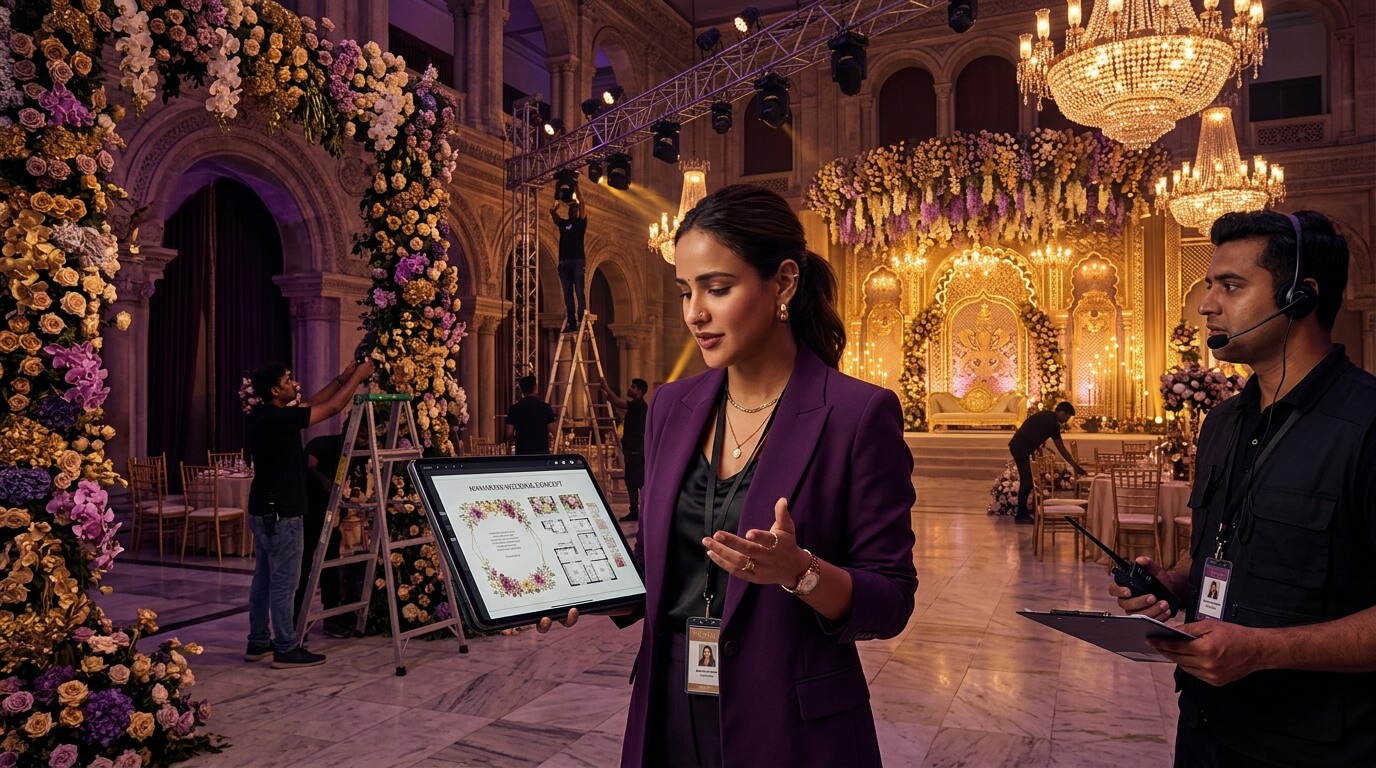
Event Concept Design: What Actually Makes an Event Feel Unforgettable
Most people think event design means flowers, stage setups, and pretty lighting.
It doesn’t.
Real event concept design starts much earlier — inside human psychology.
Before guests notice the décor, they notice emotion.
Before they admire the stage, they subconsciously feel the atmosphere.
And before they even enter the venue, the entrance itself has already started shaping their opinion about the event experience.
That’s the part most planners never fully understand.
In luxury weddings, celebrity events, and premium brand experiences across India, the difference between a “beautiful setup” and a truly unforgettable event is rarely money alone. It’s concept clarity. Storytelling. Spatial psychology. Emotional sequencing.
Behind the scenes, top event designers aren’t just decorating spaces.
They’re directing human experience.
And once you understand that shift, you stop designing “venues” and start designing memories.
Event concept design is the process of creating a complete visual and emotional experience for an event through storytelling, spatial planning, décor, lighting, guest movement, and thematic execution. It goes beyond decoration by ensuring every design element feels connected to one central narrative or emotion.
In this article, we break down how professional event designers actually think, plan, pitch, and execute luxury event concepts in India.
Why Event Concept Design Is More Than Decoration
Event concept design is not about making a venue look expensive.
It’s about making guests feel something specific.
That emotional intention changes everything.
A traditional décor company often focuses on:
- Stage
- Flowers
- Fabric
- Entry gate
- Seating
A design agency thinks differently.
They ask:
- What should guests feel when they enter?
- What emotional memory should stay after the event?
- What story does this wedding or brand represent?
- How should the guest journey unfold visually?
That difference is massive.
According to the raw conversation with Taxi Design Studio founder Vikram Chaudhary, the entrance itself becomes the “first impression” that silently shapes the guest’s expectations about the entire event experience.
And honestly? He’s right.
Guests decide within seconds whether an event feels premium, emotional, chaotic, intimate, or forgettable.
“Guests don’t remember individual décor pieces. They remember how the entire space made them feel.”
This is why modern event design agencies in India are increasingly moving away from isolated décor setups and toward immersive storytelling environments.
If you’re still exploring the foundation of the industry itself, start with what is event management because design only becomes powerful when it connects with overall event execution.
And if you want to understand why this industry is evolving so aggressively today, read why event management is a big deal.
But understanding concept design requires understanding the mindset behind it first.
How Professional Event Designers Actually Think
Professional event designers don’t begin with flowers or Pinterest references.
They begin with people.
According to Vikram Chaudhary’s experience, one of the first things a designer studies is:
- What the client likes
- What they dislike
- Their personality
- Their emotional taste
- Their lifestyle aesthetic
- Whether they prefer modern minimalism or old-world luxury
That emotional mapping becomes the foundation of the concept.
The Difference Between Styling and Storytelling
Many event setups look visually attractive.
Very few feel emotionally connected.
That’s because styling without concept eventually feels random.
A strong concept design creates visual consistency across:
- Entry experience
- Guest movement
- Stage design
- Lighting mood
- Table styling
- Sound atmosphere
- Spatial flow
- Even staff energy
Behind the scenes, what actually happens is far more psychological than people realize.
For example:
- Dark colors may feel luxurious in a nightclub event
- The same palette may feel emotionally heavy in a wedding
- Overly bright floral themes can kill intimacy during premium evening functions
- Wrong stage placement can destroy guest interaction energy
These tiny decisions completely change event perception.
Why Observation Is a Designer’s Biggest Skill
One powerful insight from Vikram’s story is that he constantly observed details around him:
- Architecture
- Fashion
- Object shapes
- Space behavior
- Human reactions
That habit eventually shaped his design instinct.
And honestly, this is where most event designers get stuck.
They learn decoration.
But not observation.
“Great event designers don’t just collect references. They collect emotional patterns.”
At Events Expert Academy, this is exactly why practical exposure matters so much. Design sensitivity cannot grow inside PowerPoint slides alone.
If you’ve ever wondered whether this industry matches your personality style, this breakdown on is event management right for you explains the emotional and professional reality behind the glamour.
Because once live guest behavior enters the equation, event spaces start behaving very differently.
Why Guest Psychology Changes Everything
The part nobody talks about enough in event management is this:
Guests psychologically “read” spaces before interacting with them.
They notice:
- Ceiling height
- Entrance width
- Lighting warmth
- Spatial openness
- Crowd movement
- Visual hierarchy
- Sound energy
- Even walking comfort
And all this happens subconsciously.
The Hidden Science Behind Guest Movement
In the interview, Vikram explains how designers think deeply about guest movement and space planning — not just aesthetics.
That’s a massive industry truth.
Because even a beautiful setup fails if:
- Guests feel confused entering
- Traffic flow blocks movement
- Stage visibility becomes poor
- Sound zones overlap badly
- Entry moments feel crowded
- Social interaction becomes uncomfortable
From actual execution experience at Smile Events, what most people don’t realize is that luxury event design often involves balancing:
- Photography angles
- Human comfort
- Crowd psychology
- Technical production
- Hospitality movement
- Vendor logistics
All simultaneously.
And when these elements align properly, guests stop feeling like attendees and start feeling immersed.
Why Storytelling Makes Guests Emotionally Engage
One of the strongest points from the transcript is the idea that a venue should “show a story,” not just look beautiful.
That’s the future of event design.
Whether it’s:
- A royal wedding theme
- A futuristic tech launch
- A nostalgic family celebration
- A cultural destination wedding
…the event should emotionally communicate something larger than décor itself.
“Luxury events succeed when guests emotionally enter the story before they physically enter the venue.”
And this storytelling mindset completely transforms the design process itself.
The Real Event Design Process Behind Luxury Events
Most people imagine event design starts with mood boards.
Actually, it starts with questions.
Lots of questions.
Professional design agencies spend enormous time understanding:
- Client psychology
- Venue limitations
- Budget structure
- Guest profile
- Lighting possibilities
- Technical feasibility
- Experience goals
Only after that does design begin.
The 5 Real Stages of Event Concept Design
| Stage | What Actually Happens |
|---|---|
| Discovery | Understanding client personality and emotional vision |
| Story Building | Creating one central narrative/theme |
| Spatial Planning | Mapping movement, stage flow, visual hierarchy |
| Production Integration | Aligning design with lighting, sound, fabrication |
| Experience Execution | Final emotional delivery during live event |
This is why elite event design agencies rarely “copy themes.”
They build experiences around emotional intent.

Why Execution Changes the Entire Design
The camera never shows this part:
- Fabric behaving differently under lighting
- Floral installations reacting to humidity
- Guest movement affecting visual balance
- LED brightness changing color perception
- Sound vibrations affecting hanging structures
In actual execution, design becomes a living system.
That’s why experienced designers obsess over production realities.
At Events Expert Academy, students are constantly taught that beautiful ideas without execution intelligence collapse quickly during live events.
This is also why understanding event project work types becomes important for designers too — because design only works when production teams, logistics teams, and execution managers align perfectly.
Because in events, design is only 50%.
Execution decides the other 50%.
What Separates a Decorator From a Design Agency
This is probably one of the most misunderstood parts of the Indian event industry.
Decor companies create setups.
Design agencies create conceptual experiences.
There’s overlap.
But the mindset difference is enormous.
Decor Focus vs Design Focus
| Traditional Decor Approach | Design Agency Approach |
|---|---|
| “Make it look grand” | “Make it emotionally memorable” |
| Focus on elements | Focus on narrative |
| Decor-first thinking | Experience-first thinking |
| Replication heavy | Concept customization |
| Visual beauty priority | Guest psychology priority |
According to Vikram, many modern design agencies don’t even execute décor directly anymore. They design concepts and collaborate with production partners to bring those ideas alive.
That shift is changing the industry rapidly in 2025–2026.

Why Clients Now Pay for Thinking
Earlier, clients mainly paid for physical setup.
Now premium clients increasingly pay for:
- Creative direction
- Emotional storytelling
- Visual uniqueness
- Spatial innovation
- Social media impact
- Experience differentiation
Because luxury today is no longer about “more.”
It’s about distinctiveness.
“A premium event doesn’t feel expensive because of money. It feels expensive because it feels intentional.”
And once budgets enter the conversation, another fascinating psychology appears.
How Budget Psychology Impacts Event Design
One of the most brutally honest sections of the interview revolves around client psychology.
Especially Indian client psychology.
Vikram explains something very real:
many middle-class clients prefer hiring executors directly instead of consultants because they feel “extra fees” reduce visible value.
That mindset heavily affects design decisions.
The Big Misunderstanding About Design Fees
Many clients think:
“Why pay separately for design?”
But what experienced planners understand is:
great design often improves value optimization itself.
For example:
- Better spatial planning may reduce unnecessary installations
- Strong focal design can reduce overspending elsewhere
- Story-driven concepts create premium perception without increasing every line item
In luxury events, perception engineering matters enormously.
Why Smart Design Sometimes Costs Less
One fascinating insight from the transcript is how Taxi Design Studio eventually built production capabilities internally to optimize cost while preserving creative quality.
That’s smart operational thinking.
Instead of simply increasing design fees, they controlled production execution and redirected savings into stronger experiences.
This is the kind of backstage operational intelligence most generic blogs never discuss.
Because real event businesses survive on balancing:
- Creativity
- Logistics
- Production
- Vendor relationships
- Client trust
- Budget perception
Simultaneously.
And this becomes very visible during real-world wedding projects.
Case Study: Designing High-Impact Wedding Experiences
One story from the interview perfectly captures how elite event design works.
A nightclub-themed wedding concept was being designed under strict budget realities. Instead of blindly copying references, the design team:
- Reimagined guest flow
- Changed stage positioning
- Created immersive center-focused layouts
- Used technology creatively
- Prioritized emotional energy over decorative excess
That’s real design thinking.
Not random Pinterest replication.
Why Spatial Energy Matters More Than Expensive Decor
Most Indian wedding layouts still follow predictable patterns:
- Long stage at one end
- Guest seating opposite
- Empty middle space
- Decorative backdrop behind stage
But when designers rethink movement and engagement, the atmosphere changes completely.
Guests interact differently.
Photos feel dynamic.
Energy circulates better.
This is exactly why some weddings feel “alive” while others feel mechanically beautiful.
And honestly, that emotional difference is what premium clients increasingly notice.
If weddings specifically excite you, this detailed guide on how to become a wedding planner in India and the complete wedding planning process in India will help you understand how modern luxury weddings are actually executed behind the scenes.
“The strongest event concepts don’t copy trends. They create emotional worlds people want to stay inside.”
Why Storytelling Is the Future of Event Design
The Indian event industry is shifting rapidly.
Especially after 2024’s explosion of high-visibility luxury weddings, immersive brand launches, and experiential events.
Today, audiences don’t just want decoration.
They want:
- Atmosphere
- Immersion
- Narrative
- Emotional connection
- Instagram-worthy moments
- Cinematic environments
- Personalized experiences
And this shift is creating massive demand for designers who understand both creativity and execution.
That’s why practical learning matters more than ever.
If you’re serious about building a future in this industry, explore how programs like the hybrid event management course and best online event management course expose students to the real operational thinking behind modern event execution.
And for students who specifically want offline practical exposure in Mumbai, the diploma in event management Mumbai page explains how live industry learning environments work beyond theory-heavy classrooms.
Because event design is no longer just decoration.
It’s experience engineering.
Frequently Asked Questions
Event concept design is the process of creating a complete visual and emotional theme for an event using storytelling, décor, lighting, layout planning, and guest experience design.
Event décor focuses mainly on visual elements like flowers and stage setups, while event design focuses on the complete emotional and spatial experience of guests.
Luxury event designers usually begin by understanding the client’s personality, preferences, emotional goals, and venue possibilities before building a concept narrative.
Guest psychology affects how people emotionally experience spaces. Lighting, movement, sound, entry design, and atmosphere all influence how memorable an event feels.
Yes. With the rise of luxury weddings, experiential marketing, and destination events, skilled event designers are increasingly in demand across India.
Some do. Many modern event design agencies now combine creative design with production management to maintain better quality control and budget optimization.
The best way is through practical exposure, live projects, mentorship, and understanding both design psychology and execution realities through industry-based learning environments.
Final Thoughts
Most people enter events thinking the industry is about decoration.
Then they enter a live setup at 2:30 AM.
They watch lighting teams adjusting mood temperatures.
Production crews rebuilding installations.
Designers repositioning structures because guest flow feels wrong.
Sound engineers reshaping atmosphere through frequency.
Hospitality teams preparing emotional moments guests will never notice consciously — but will always remember emotionally.
And suddenly, event design stops feeling superficial.
It starts feeling architectural. Psychological. Cinematic.
That’s the real world behind luxury events.
The event industry rewards people who can combine creativity with execution intelligence. If this article made you realize how deep event design actually goes, then your next step isn’t just learning décor trends. It’s learning how experiences are truly engineered behind the scenes through real projects, real spaces, and real execution environments.

Your Career In Events Starts Here
India's most practical event management training. Real events. Real earnings. Real industry connections.