
What Is Event Management… Really?
Most people think event management means planning an event.
- Booking a venue.
- Arranging décor.
- Calling vendors.
- Managing timelines.
But honestly?
That’s surface-level understanding.
Because event management is not really about tasks.
It’s about control.
Control over hundreds of moving parts happening simultaneously, in real time, under pressure, with no second chance.
And that’s what makes this industry so fascinating.
- A wedding.
- A concert.
- A product launch.
- A corporate summit.
- A luxury experience.
They may look smooth from the outside.
But behind the scenes?
They operate like living systems.
Table of Contents
What Is Event Management?
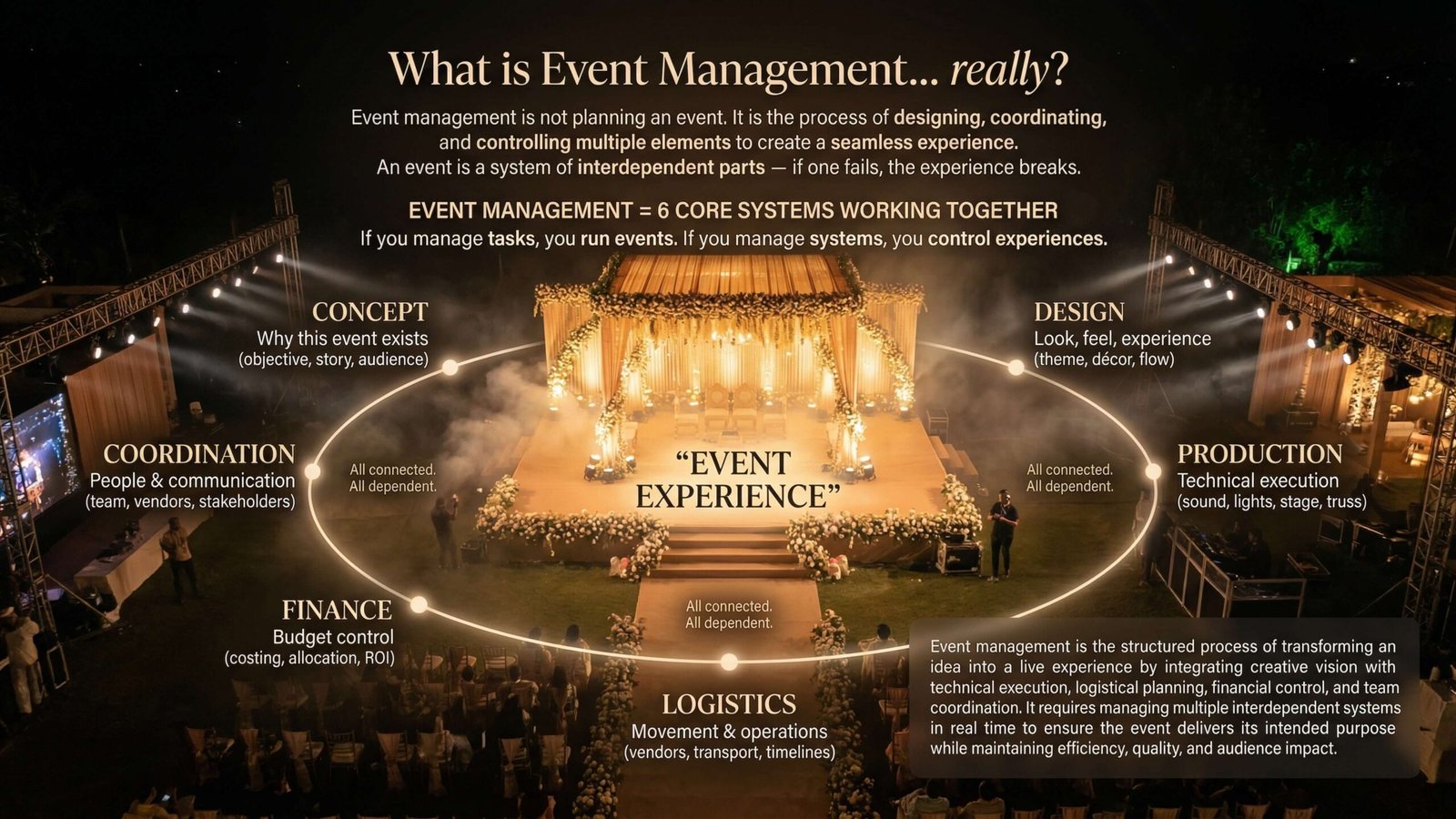
Event management is the process of transforming an idea into a live experience by combining:
- creative vision
- production execution
- logistics
- coordination
- finance
- hospitality
- audience psychology
all into one seamless system.
But the important word here is: system.
Because events are not isolated tasks.
They are interconnected operational ecosystems.
“The best events feel effortless only because the hardest work stays invisible.”
And this invisible work is what real event management is all about.
Why Most People Misunderstand Events
Most guests only experience the final output.
They see:
- beautiful décor
- stage lights
- artist performances
- hospitality
- smooth transitions
- luxury experiences
But they never see:
- vendor delays
- backstage troubleshooting
- production timelines
- power backup planning
- guest flow management
- communication systems
- coordination pressure
And honestly?
That’s why event management is one of the most misunderstood industries.
Because when execution succeeds, nobody notices the complexity behind it.
The Real Definition of Event Management
Event management is the structured process of controlling multiple interdependent systems in real time to deliver a seamless experience that fulfills emotional, operational, strategic, and financial objectives simultaneously.
That sounds intense.
Because it is.
Unlike many industries, events happen live.
There is:
- no pause button
- no “undo” option
- no software patch later
Once guests arrive, everything must work together at the same moment.
And this is exactly why execution matters more than theory.
Think of an Event Like a Live Concert
Imagine this.
The artist is ready.
The crowd is excited.
The stage looks stunning.
Now suddenly:
- sound cuts for 10 seconds
- lights fail during entry
- guest access gets delayed
- food counters collapse operationally
Individually?
Small problems.
Collectively?
The experience gets destroyed.
That’s event management.
Not decoration.
Not just coordination.
But ensuring multiple systems function together under pressure.
“Events don’t fail because of one big mistake. They fail because small systems stop communicating.”
The 6 Core Systems of Event Management
Every successful event operates through six interconnected systems.
And honestly?
Understanding these systems changes how you see events forever.
1. Concept — Why Does the Event Exist?
Every event begins with purpose.
This stage defines:
- audience
- intention
- emotional direction
- messaging
- experience goals
Without a strong concept, the event has no identity.
Whether it’s a luxury wedding or brand launch, the concept drives every later decision.
2. Design — What Will People Feel?
Most people think design means decoration.
Wrong.
Real event design shapes emotional experience.
This includes:
- spatial flow
- lighting psychology
- atmosphere
- color mood
- stage aesthetics
- sensory engagement
“Design is not decoration. Design is emotional engineering.”
That’s why great events feel immersive.
3. Production — How Will It Actually Work?
Production is the technical backbone.
This includes:
- sound systems
- trussing
- LED walls
- lighting rigs
- staging
- power systems
- special effects
This is where imagination becomes physically executable.
And honestly?
Production is where many beginner planners underestimate complexity.
4. Coordination — Who Handles What?
Events involve multiple stakeholders simultaneously:
- vendors
- artists
- guests
- hospitality teams
- venue management
- production crew
- planners
Coordination ensures:
- timing
- communication
- task clarity
- escalation systems
Without coordination, even beautiful planning collapses operationally.
5. Logistics — How Does Everything Move?
Logistics is invisible.
But it controls everything.
This includes:
- transport
- setup movement
- inventory flow
- entry systems
- guest movement
- backstage operations
- loading/unloading
And honestly?
Good logistics feels invisible because guests never notice it.
That’s the magic.
6. Finance — Is the Event Sustainable?
Every decision affects cost.
Finance includes:
- budgeting
- allocation
- profitability
- ROI understanding
- vendor negotiation
- contingency planning
Because events are not just creative projects.
They’re business systems too.
Why Events Fail
Most people think events fail during execution.
Usually?
They fail much earlier.
Behind the scenes, failure often begins through:
- poor planning
- weak communication
- unrealistic budgets
- timeline delays
- unclear responsibilities
- missing contingency systems
And because events happen live, problems multiply fast.
That’s why experienced planners obsess over systems before event day.
Different Experts Define Events Differently
One fascinating thing about event management is this:
There is no single definition of an “event.”
Different experts see events differently:
- Philip Kotler → communication platform
- Leonard Hoyle → designed experience
- Bowdin → cultural and social expression
- Harold Kerzner → milestone system
- Robbins & Coulter → organizational occurrence
And honestly?
They’re all correct.
Because events are multidimensional.
A wedding is:
- an emotional experience
- a cultural ritual
- a hospitality operation
- a logistics system
- a production environment
all at the same time.
Event Management Is System Thinking
This is the biggest insight most beginners miss.
Event management is not task management.
It is systems thinking.
Because changing one thing affects everything else.
For example:
- delay logistics → production suffers
- overspend décor → finance collapses
- poor coordination → guest experience breaks
- weak hospitality → emotional experience fails
And this interconnected thinking is exactly why event management builds such strong real-world intelligence.
Why the Industry Is Becoming More Important
The global experience economy is growing rapidly.
Brands increasingly invest in:
- experiential marketing
- immersive launches
- creator events
- destination weddings
- luxury hospitality experiences
- live entertainment
Why?
Because human beings remember experiences more deeply than advertisements.
That’s why companies today prioritize emotional engagement over visibility alone.
And event management sits exactly at the center of that shift.
Want to Learn Event Management Practically?
Explore practical learning through:
FAQs
What is event management in simple words?
Event management is the process of planning and executing events by coordinating design, logistics, production, people, and operations into one smooth experience.
What are the main elements of event management?
The six major systems are: concept, design, production, coordination, logistics, finance.
Why is event management difficult?
Because events happen live. Multiple systems must function together simultaneously without mistakes.
Is event management creative or technical?
Both. It combines creative experience design with technical execution systems.
Why is event management important?
Event management creates emotional human experiences while developing leadership, execution, logistics, and problem-solving abilities.
Is event management only about weddings?
No. The industry includes concerts, festivals, corporate events, experiential marketing, luxury hospitality, and entertainment events.
Final Thoughts
Most people think events are about celebration.
But behind every celebration is a hidden operating system.
- Timelines.
- Production.
- Communication.
- Hospitality.
- Coordination.
- Pressure.
- Emotion.
- Execution.
And honestly?
That invisible complexity is what makes event management such a powerful industry.
Because event management is not just about organizing events.
It’s about orchestrating human experiences in real time.

Stop Guessing. Start Executing.
You just saw the reality of this industry. Now step inside it. Learn how to architect these experiences flawlessly in the real world.